If you’re tired of feeling stuck in your grief or in your life, this is the episode for you. After a miscarriage, stillbirth or any kind of baby loss, it can feel like you’re standing still while the world turns around you. You still have goals and dreams but they can feel impossible to achieve. You know what you want, but you don’t know why you can’t get motivated.
I’ve got the exact reason you are stuck and the way to fix it!
Listen in and you’ll be moving in no time.
Transcription
Welcome to Smooth Stones, episode 196. The reason you’re feeling stuck and how to fix it. I am not gonna leave you hanging. Today, we’re gonna talk about why we get stuck. No matter if it’s for a goal, something you wanna do, or a relationship you wanna get better. All the things. Why we get stuck. And then I’m not gonna leave you hanging.
I’m gonna tell you how to fix it. And it’s actually way more simple than you think. ’cause once you understand why you’re stuck, it’s really easy or a lot easier to get out of it and to keep taking steps to move forward. I want you to be able to envision a life no matter where you are now, no matter where you’re stuck, I want you to be able to envision a life.
Where you do get the things you want. Uh, I was just working with a client and I, I love it so much when we can, sure, we can sit and talk about all the things and why we’re stuck and like what’s wrong with us. But it’s so powerful when you can have that vision for your life, that vision for the things you want, and then start moving towards it.
And I think when we do that, when we open that up, it just. It starts to flow. , I first wanna preface this by saying I want you to take into account your individual circumstances. When I talk about coaching concepts, when I teach you things, I want you to use it to help you, not to hurt you, not to beat yourself up, and this is gonna be most effective if you are able to be at kind of a base level of mental, physical, emotional health, and then kind of move from there.
Rather than if you’re kind of in a deep, dark hole, you might need some extra support to get up out of that hole and then use these concepts. So if you are dealing with depression, if you’re really feeling stuck to an extent or degree that. Needs that support. Please do that. Please don’t use this to hurt yourself and say, why can’t I get going?
What is my problem? Um, life is hard. Grief is hard. There’s a lot going on. If you are in survival mode or you have some things that are extra difficult, get the support you need. Uh, coaching is, like I said, gonna really be a fit. When you’re ready for it, so take what works and leave the rest and all that to say.
I don’t think grief necessarily means that you can’t use these concepts because I know that I was able to make some decisions and switch some thoughts and like understand and work with myself and my relationship with myself. In really raw grief after my daughter was stillborn. So I never count anyone out.
I just want you to be aware. If anything I say, your brain wants to take it and twist it in order to criticize yourself. Um, that’s never my intention. And I want you to get help near you from family, friends, professionals, whatever you need to do. All right. So again, what I wanna do today is let’s dive in to what is going on with us as humans.
And a lot of times we think it’s just me, like there’s something wrong with me. We’re gonna throw that out the window today and we are going to talk about the motivational triad. Now, this is something, you can Google it. It’s not something I created. It is something that all human brains. Have, so there are three things that, I don’t know why it’s called the motivational triad, but it’s like the un motivational triad.
It’s the things that stop us. It’s the obstacles our brain puts in the way. It’s the goal of our brain, and especially the primitive part of our brain. We know often it’s like, well, I wanna do this cool thing. But I just can’t get going. So that’s where our primitive survival, you know, whatever, like lizard brain, there’s lots of words for it, but lower brain, this is what’s going on there.
It has three goals. Seek pleasure. So we know we like the nice things, we like the sweet things, we like the comfort. We have avoid pain. And our brain doesn’t differentiate between physical pain, emotional pain, um. Things that are sapping our energy, whatever it is, it’s just gonna avoid all of it, right?
Even if it’s pain, we want, like if you decide to be run a marathon, it’s like, I don’t really wanna do that. That sounds painful. And then conserve energy, same things. Um. It does not wanna get off the couch. It doesn’t like in its happy place. Our primitive brain is saying, you don’t know if a tiger’s gonna chase you.
You don’t know when food’s coming next. You don’t know. You know what the weather’s gonna do. You better conserve your energy to stay alive. So I will repeat those again. Our brain’s motivational triad. Seek pleasure, avoid pain, conserve energy. When you understand that, you can recognize this is not a me problem.
Now all of us have different like relations to this in our life. We all have different beliefs, different patterns, different habits, um, ways we’ve grown up all of that. It’s gonna play into it. But if you can understand, actually my brain is really wanting me to survive by doing these three things. Mm. But that doesn’t really help us thrive, right?
We’re not doing things that push us. We’re not doing sometimes the basic things that we wanna do, right? Like folding the laundry. Why does it seem so hard? Because our brain wants to seek pleasure, avoid pain, and conserve energy. So folding laundry doesn’t really sound like a thing it wants to do. Let’s add in grief brain.
Let’s talk about that for a minute. Now, whether your baby just died or it’s been years, this might still be a part of your experience right now. Um, so I actually have really looked into this and I was looking up some more things and so I have some like brain words, but here’s basically what happens in grief, and this is factual.
A lot of times, again, we’re like, what is wrong with me? Why can’t I do this? Why can’t I do that, um, in our grief? And so what happens when we experience grief is it triggers neuroplasticity, and that just means that our brain is able to adapt and it changes based on different things that happen. Um, so it grief.
Rewires our brains to cope with loss and we get these grief brain symptoms, which are or can be brain fog, forgetfulness, difficulty concentrating. Have we all experienced that? Yes. Um, it causes the overactivation of the amygdala, which is our fear center and also our stress hormone cortisol release. So we’ve got extra fear, extra stress hormones running through our body, and then at the same time, it’s deactivating our prefrontal cortex, which is our higher brain or rational thinking brain.
Then, um, the hippocampus, which is responsible for memory, can also be impacted, potentially shrinking from prolonged stress. Now, that kinds, that sounds. Kind of terrifying. Um, but I promise you’re gonna be okay. ’cause even if you do, you know, this is why like we black out or we can’t remember, or we’re like, why can’t I remember the details?
Why can’t I remember the nurse’s name? I, she was so sweet to me in the hospital, but like, I have no idea what her name was anymore. Um, it’s why we have this heightened alert after our baby dies or something bad happens. We’re like looking for danger everywhere. Because our brain has changed and this, I mean, for me, I don’t know, this can last a long time.
I think this can be, you know, healed and put back, not put back, but like, we can work through this. We can work with this. We can allow for it, we can adapt. That’s the cool thing about being human, but this is a real thing. So. Understanding this. So again, the reason you’re feeling stuck, we’ve got the motivational triad, we’ve got grief brain, which really does, to me, it like narrows the focus.
It’s like you really do have to go actually into survival. And when you’re in survival, maybe you don’t have the capacity to do other things, and that’s okay. And if you want to do other things. If you wanna make some goals, you can do that. That is available. You just gotta understand, hey, this might be a little bit difficult.
I might have to do it a different way because I have these things, um, affecting me right now. So let’s talk about when we want to do something, but we’re not doing it. So will you think for me. For yourself, actually think about something you want to do, but you felt stuck. Maybe it’s having a conversation, maybe it’s, you know, a project.
Maybe it’s a goal. Maybe it’s, I don’t know, a million things. You name what for you. But if I just said, where’s a spot in your life that you’re stuck? Give yourself a moment, think about it. Um, and kind of keep that in mind as we talk about the rest of this. Now we, we ask these questions in coaching and really, if you wanna get unstuck, I highly encourage you to come talk to me.
I actually have holiday coaching sessions right now. Um, I’ve got a couple spots open. We can come and get unstuck. Doesn’t matter if it’s related to the holidays. Having someone else there can really, really be helpful, especially someone who understands what’s going on when we can’t see it. But when we don’t do something, a lot of times we’ll say, why?
What’s wrong with me? I should be able to do this. One of the other ways that we stay stuck is we don’t recognize that this is actually serving us. And when I say that’s serving you, I mean it is benefiting you in some way. Now sometimes it feels terrible, so we wouldn’t, we’d be like, well, I feel terrible.
That’s not really benefiting me. That’s not serving me. But actually our brain loves. The familiar, uncomfortable, more than the unfamiliar, uncomfortable. It hates the unknown, so it will do again, anything to avoid the unknown. And so when I ask this question, usually at the beginning, people say like, oh, I don’t, this is not serving me.
This is terrible. I don’t like it. I don’t like that. I’m not moving forward. I don’t, I don’t like it. I don’t like the way my relationship is right now. I want it to be different, but it’s like somewhere inside of you, you actually don’t want it to be different. It is serving you. So for example, if I wanna do a coaching business, I’m like, well, I probably wanna talk to people online.
I wanna get on Instagram. If I get on Instagram and. I see, oh, there’s this new thing called reels, and it’s kind of like TikTok and they, you know, there’s like, oh, you can make a video and it changes like every couple of months, and as soon as you figure it out, they change it again. If I just get stuck on how to make a reel, if I just get caught up in like, how my hair looks or how my lighting is, or like all the things, then I, I could sit there and say.
Oh my gosh. Like I really wanna get this business off the ground. But man, these Instagram reels, it’s just too hard. I don’t understand it, you know, I’m afraid of all these things. But how is it serving me to stay stuck on creating reels on Instagram? Well, for example, I don’t have to put myself out there.
Right. I don’t have to face humiliation. I don’t have to deal with people’s comments. I don’t have to have the, you know, the feeling of trying and only getting crickets. There’s all these reasons why actually staying stuck in this never ending cycle of blaming, you know, the tool. Because that means I don’t have to do the other scary things.
Does that make sense to you? Think about it in your particular situation, when you are stuck somewhere, and even if it feels miserable, how is it serving you? How is it protecting you? How is it actually somehow in your brain the best choice? Because that is a huge reason we get stuck, and one of the ways this shows up is we will take what I call passive action.
So that is like I’ll buy a course on how to do an Instagram reel. Right. I’ll, I’ll buy a course on how to go viral. I’ll, you know, invest in, I’ll buy a whole bunch of stuff on like lighting and a backdrop and I’ll mess around with, if you’ve watched any of my stuff, I have a bookshelf behind me and it’s like all, you know, arrange the bookshelf so it’s all perfect and all of those things because it feels like you’re doing something and it feels like you’re busy.
But actually. Nothing is happening. Like you are not moving forward. You’re still not putting yourself out there. You’re still not, you know, trying your thing and failing. You’re not doing actual action. Now, I do think learning is great, but we really have to watch how is that my brain seeking pleasure?
Avoiding pain and conserving energy because sometimes that seeking pleasure is like, oh, I feel good when I just learn. I feel good when I’m consuming. Um, and it’s a lot less scary than producing. So watch out for passive action. Understand how it’s serving you to stay stuck and when you can question yourself with compassion.
And really just explore, just try to understand. I also will caution you sometimes we do a lot of self-coaching, like we’re really like trying to figure out why we’re not doing anything that is also sometimes passive action, right? It’s like, if I could just figure this out, if I could just fix myself, then I’ll start doing the thing.
Then I’ll get unstuck. Um, so actually as I was. Getting ready for this episode and I was looking always on my, um, what’s it called?
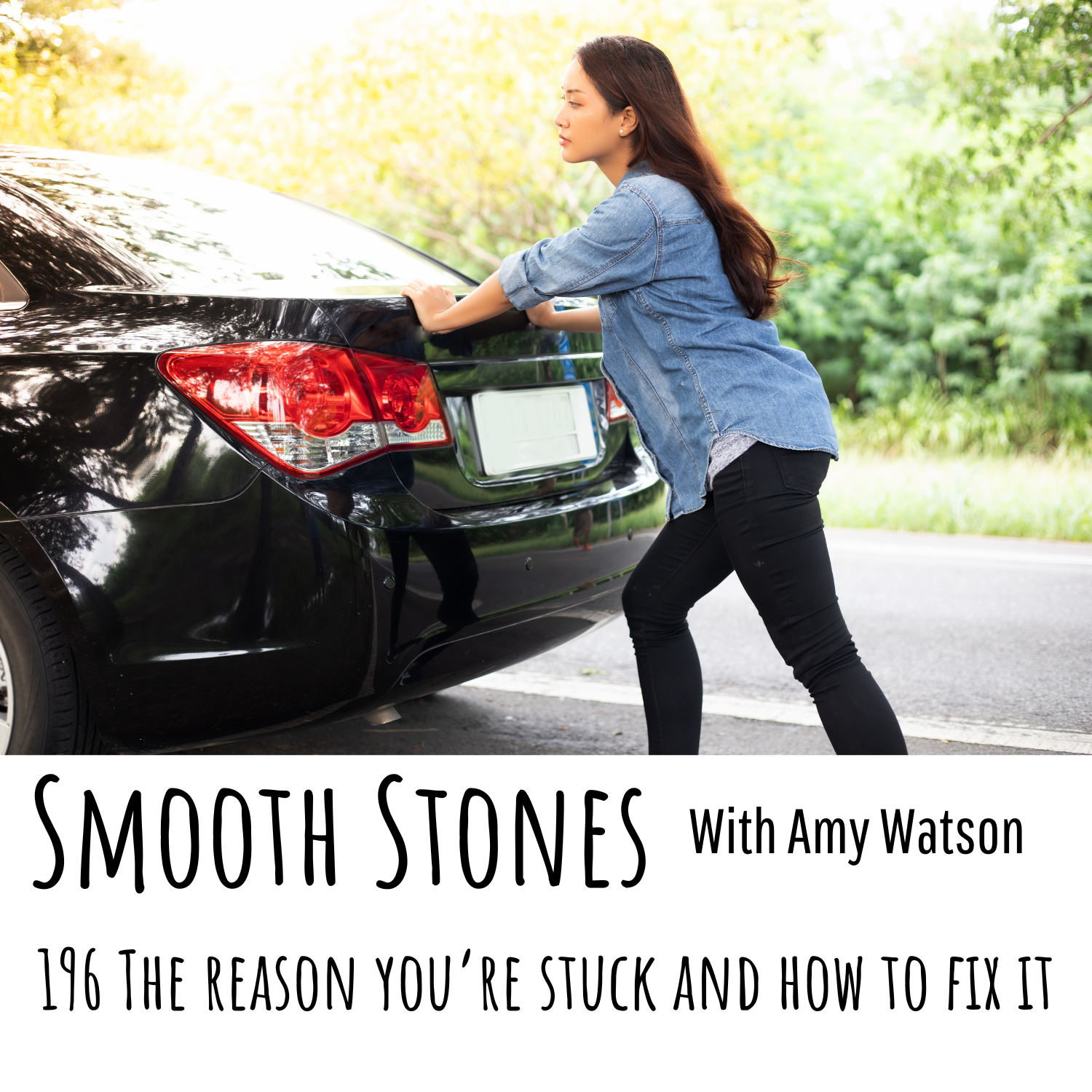
As I was getting ready for this, this podcast, I wanted to do my cover. A lot of times I’ll pick a picture to go on the cover that, that goes with the theme. And so I was looking up all these pictures of like people stuck in the snow and people stuck in the mud and, and all of that. And I. I thought a lot about it because I am from Canada.
In Canada where I lived, there was a lot of snow for a long time in the winter and I have had plenty of chances to slide into a ditch to get stuck, um, to kind of like park your car somewhere and it’s fine, and then it snows all day and you come out and it’s just stuck. It really is tricky. So I have a lot of experience getting out of.
The side of the road, out of some ice, out of some snow. And listen, that first part is really hard, right? Your tires are spinning, it’s icy. You’re like, oh crap. Like I’m stuck. You know? You’re trying to figure it out. You.
That first part when you’re, you’re trying to get unstuck, you’re trying to figure it out. You’re seeing what you’re working with. You’re like, am I alone? Is it dark? All the things. Um, it can be really hard. And then. You gotta get someone to help you push, right? Uh, I think it can be really, really helpful to have people who are gonna help you get over this hump.
But the truth is, we gotta get going. And what happens when we’re stuck is that first push, you’re rocking back and forth. You’re putting stuff under the tires, you’re digging the snow. You’re like. Try not to spin. You’re trying to push, you know, there’s like a pattern that if you can get moving and you can get momentum, you can get going, then you can get out and that stuck part can feel really frustrating and you can try a lot of things and I understand that is really, really frustrating.
So again. As you’re on the side of the road, metaphorically, what often comes up is our inner critic. So we are stuck, and then we’re gonna add this inner critic with some nice judgment of like, you shouldn’t have done this. You should have gotten different tires, you should have gotten slower, you should have whatever.
Or maybe we’re blaming right? Somebody else, it’s their fault that you’re stuck. Um, there’s a lot going on, but a lot of times. We pile on this criticism that just makes it worse. So I wanna encourage you, if you’re feeling stuck, watch out for that inner critic and give yourself some love and some compassion.
Actually, sometimes you can listen to your inner critic and be like, oh, they have some wisdom. They’re noticing some places where there’s friction, they’re noticing some problems, and maybe I can love that voice and listen to it. And sometimes you just gotta tell it to go away. Like you just gotta say, I’m not listening to you right now.
I don’t need this extra layer of pain. I don’t need this extra layer of suffering like. I am doing the best I can and I’m for sure gonna move forward because the thing that happens when we’re stuck is we really start to erode our relationship with ourself, right? We start blaming ourselves, we start thinking there’s something wrong with us.
We don’t understand that it’s just a human brain that’s really a big problem and like the grief is adding to it. Um, but if you can just. Love yourself. Give yourself some kindness. Um, you are gonna be able to move forward so much more easily. And the thing is, once we get over those bumps, once we push, once we, you know, rock back and forth and get some traction, we get back on the road.
We get to go. Right now we’re on asphalt, now we have grip. Now we can start rolling. I think that’s really important is understanding like sometimes it does just take being willing to be uncomfortable. Being willing to get sprayed in the face with snow, be willing to get a little cold, all of that to push in order to get out of it and be good to go.
So what that looks like is we have to
happy come on. Can you stop luing, like I can see you just lurking. I’m two minutes from done, but it’s like really hard to focus. No, just like for real. Just, I know I said whatever time, but just go over there for like two minutes. I.
This is where we have to take massive action. So if passive action is consuming and learning and kind of like spinning our wheels, which sometimes, like I said, that can be helpful if we don’t do it too much. If you do it too much, you’re just digging a hole. You’re never gonna get out of. But recognizing like it feels good to the brain, it feels productive, and it’s doing that motivational triad for you.
So you really gotta be onto yourself. But we want to take the massive action. We want to rock the boat, we wanna rock the car, we wanna like put sticks and gravel and stuff under the tires. We want to do those things so that we can get. Going massive action is taking steps that actually get you to your goal.
And as I said before, in your grief, this might look like extreme rest. It might look like cutting everything outta your schedule. It might look like finally saying no to people. It might look like a lot of things. Um, I never want you to be criticizing yourself, especially in grief. If you’re in raw grief.
If you’re in a grief wave. You gotta just take care of your survival and you can also be taking these steps. I really think sometimes we have the most power in that version of us, and it’s a beautiful thing. So it you felt stuck somewhere. Think about the spot that you came up with. What do you actually need to do that will move you closer to your goal if you wanna repair a relationship?
You gotta make the conversation like you might have to be the one to reach out. You have to do the things instead of sitting and stewing about it and criticizing you and criticizing the person and just feeling terrible, right? We don’t want the familiar terrible that keeps us stuck. We want the uncomfortable that comes from like doing the thing.
So that is my message to you today. Understand yourself, understand that our brain is wired for survival. And sometimes that can seem like it’s working against us, but as long as you understand it and you just start taking little tiny steps of massive action, you absolutely can do this. Take care of your heart, be kind to yourself.
Get support. Like I find for me that when I have someone else to be able to talk through things with, when I have someone else who I trust, when I have someone who can keep me accountable, it gets so much easier. So I really think that if you’ve been on the fence about maybe coming and talking to me for coaching, you should totally do it because I’m really nice and I love helping people get unstuck no matter what.
All you gotta do is come on over on my website, send me an email, amy@smoothstonescoaching.com, or DM me on Instagram. I would love to chat with you and see how we can get you unstuck. I believe in you. You are amazing. You’re not broken. You don’t have to fix yourself. You just gotta keep trying. Keep living.
This life is for you and there’s so much beauty in it. I see you next time.